Hybrid Wellness Programs: The Complete Guide to Blending In-Person and Digital Wellness for Distributed Workforces
Introduction
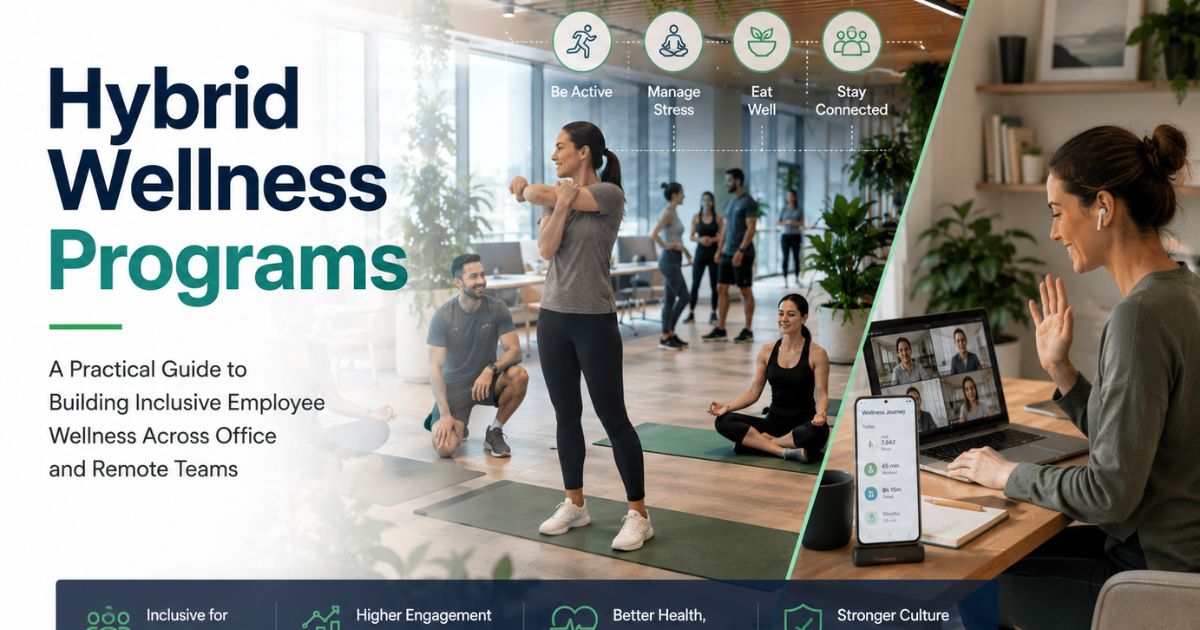
The workplace is no longer mostly in-office. Many companies now have hybrid or remote teams. That means wellness programs must change too. Hybrid wellness programs are the answer. They blend digital tools with flexible formats so employees in any location or time zone can join.
Programs built only around onsite gyms and in-person classes leave remote staff out. Programs built only for remote workers miss the value of in-person community.
The solution is hybrid wellness. These programs work for everyone—whether an employee is in the office, at home, or somewhere in between.
Companies that get hybrid wellness right tend to see:
- Meaningfully higher participation than office-only programs achieve at the same company
- More equal engagement across office, remote, and hybrid segments
- Stronger retention among remote workers, who often feel more disconnected
- A stronger, more unified culture across distributed teams
This guide covers how to design, implement, and measure a hybrid wellness program that reaches every employee, wherever they work.
Why Hybrid Wellness Is Different — and Necessary
The Problem With Office-Only Wellness
Traditional wellness programs assume people are in the office. They often include an onsite gym, in-person classes, cafeteria nutrition plans, or walking meetings. But these options don’t work once an employee is remote. Participation in office-based wellness programs is always much lower among remote workers compared to those who are in the building.
The Problem With Remote-Only Wellness
Going fully digital doesn’t solve the problem. Apps and online classes often feel empty. There is no shared experience—no walking groups, no gym partners. This can make people feel even more alone. Office workers may also feel that digital-only programs ignore what they want.
The result: engagement drops when community is missing, and it is harder to build healthy habits alone.
The Hybrid Solution
Hybrid wellness blends both:
- In-person options for office employees and hybrid days
- Digital/virtual options for remote employees and any day
- Flexible access so everyone can participate regardless of location
- Community bridging that connects remote and office employees together
This combination is what ensures equal access and maximizes participation across every work arrangement.
The Hybrid Wellness Framework: 6 Components
1. Flexible Fitness Access
On office days, employees can use onsite gyms and join in-person classes. For remote staff, offer virtual classes, fitness apps, or home equipment stipends. Connect both groups with live-streamed sessions that everyone can join. Add simple challenges, like step counts, that work no matter where people are.
2. Mental Health Support
This one’s naturally hybrid already. Virtual therapy and meditation apps work equally well for everyone, everywhere, since counseling is increasingly virtual-first anyway.
3. Nutrition Support
Cafeteria options and cooking demos in the office; virtual nutrition coaching, meal planning apps, and grocery delivery subsidies for remote employees.
4. Community & Social Connection
The hardest component to make hybrid, and the most important. Combine office wellness events and walking groups with virtual challenges, wellness Slack channels, and live team workouts. The real bridge is company-wide challenges where remote and office employees compete together, not in separate tracks.
5. Preventive Health & Screenings
Onsite biometric screenings for office days, paired with at-home screening kits, virtual health assessments, and telehealth for remote employees.
6. Ergonomics & Physical Environment
Often overlooked, but critical. Ergonomic furniture and standing desks in the office; home office stipends and virtual ergonomic assessments for remote setups.
Building Your Hybrid Wellness Technology Stack
Employees should not need many different apps based on where they work. Pick one platform that works on both mobile and desktop. It should connect with wearables like Fitbit or Apple Watch. It should offer live and on-demand content. It should include challenges and leaderboards. It should also link with video tools for live classes. Most importantly, it should give equal access to all employees, no matter their location.
Hybrid wellness technology may cost more than office-only programs. This is because of extra integrations, wider gym access, equipment stipends, and virtual class production. But the return is higher, since the program reaches more of your workforce.
The 5-Month Hybrid Wellness Rollout
- Month 1 — Assessment & Design
Survey your workforce. Find out how many are remote or in-office and what barriers they face. Then design the program and choose one platform that works for everyone. - Month 2 — Technology & Partnerships
Pick your platform. Set up gym partnerships. Prepare clear communication for launch. - Month 3 — Launch
Get leadership aligned across all locations. Launch with both virtual and in-person kickoff events. - Month 4 — Engagement
Run your first company-wide challenge. Track participation by group. Watch closely to see if remote employees are falling behind. - Month 5 — Optimization & Measurement
Collect feedback from different groups. Compare participation and engagement. Measure ROI to see the program’s impact.
Ensuring Equal Access: The Real Hybrid Wellness Challenge
The biggest risk is unintentional bias toward office employees — where “hybrid” really means office-first with digital bolted on as an afterthought. Watch for warning signs like the best instructors only being available in person, or leadership participation only being visible in the office.
Five strategies keep the program genuinely equitable:
1.Design remote-first. Build the program to work fully online. Then add in-person options on top.
2.Spend equally per employee. Track wellness costs per person, no matter where they work.
3.Use universal challenges. Step counts, workout logs, and meditation minutes work anywhere. Avoid challenges that require being in the office.
4.Show remote leadership. Make sure remote leaders join and are visible. If only office leaders take part, remote staff may feel left out.
5.Measure by group. Track participation for office, remote, and hybrid employees separately. Look into any gap bigger than 15–20 percentage points.
Measuring Hybrid Wellness Success
Track these metrics, always broken out by segment:
- Participation equity. Keep the gap between groups as small as possible.
- Engagement equity. Sessions per month, challenge completions, and app use should be close across groups.
- Satisfaction by segment. Scores should be similar for office, remote, and hybrid employees.
- Community connection. This is often the weakest area, so watch it closely.
- Overall ROI. Use standard wellness ROI measures but break them down by work type. Remote retention gains are often the most valuable, since remote staff have more freedom to leave.
Common Mistakes to Avoid
- Office-first design. Don’t treat remote access as an afterthought.
- Apps alone aren’t enough. Equity needs real virtual community, not just software.
- Respect regional differences. Costs, resources, and culture vary for remote staff.
- Measure by group. A strong overall number can hide gaps if office, remote, and hybrid rates aren’t tracked separately.
- Show leadership everywhere. If only office leaders are visible, remote staff may feel excluded.
- Invest in virtual community. Don’t spend heavily on physical facilities while ignoring online connection.
The Business Case for Hybrid Wellness
Hybrid wellness often gives better ROI for clear reasons:
- It reaches more people in a distributed workforce.
- It lowers the risk of remote employees leaving because they feel disconnected.
- It makes your company stronger in the remote talent market.
- Digital tools usually cost less per person than physical facilities.
Conclusion
The future of work is hybrid. Wellness must follow.
Companies that build true hybrid wellness programs — with equal access for all employees — see better results. Participation is stronger. Engagement is more consistent. Remote retention improves. Talent competitiveness rises. ROI is higher.
If you want to build or rebuild your program, follow this path:
- Assess your workforce and their needs.
- Design remote-first, then add office options.
- Choose one platform that works everywhere.
- Roll out in five months.
- Measure equity across groups.
- Close participation gaps as they appear.
By next year, your wellness program could reach and engage your whole workforce more equally. That is the goal of hybrid wellness done well.